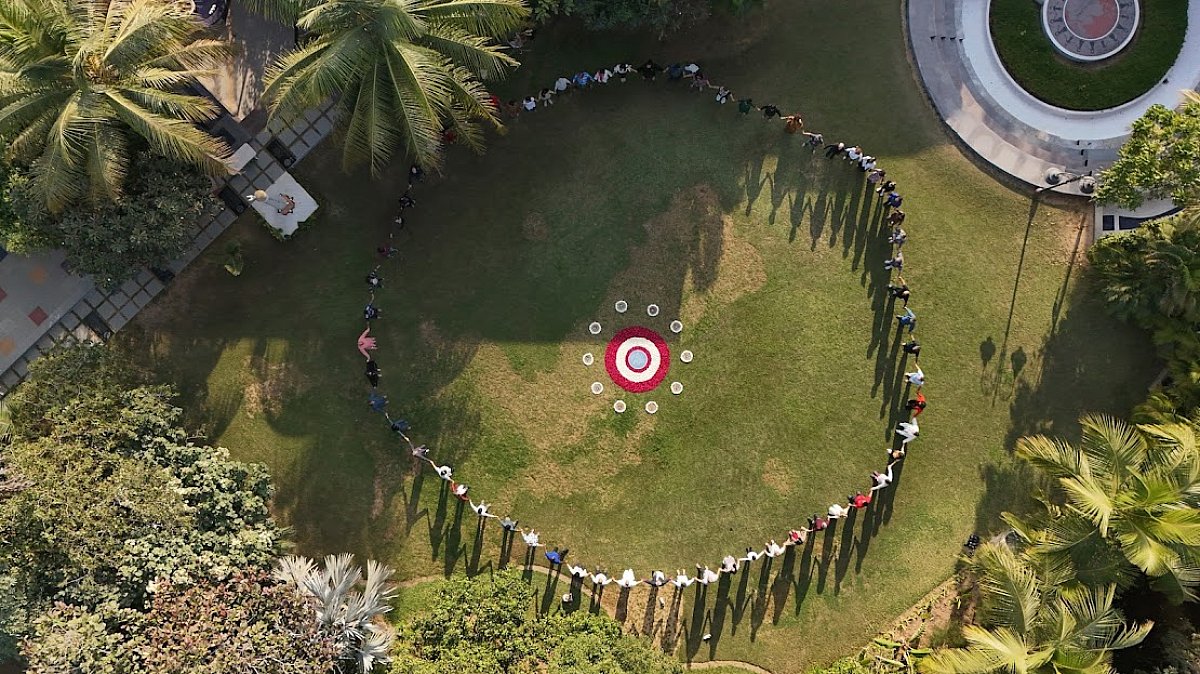
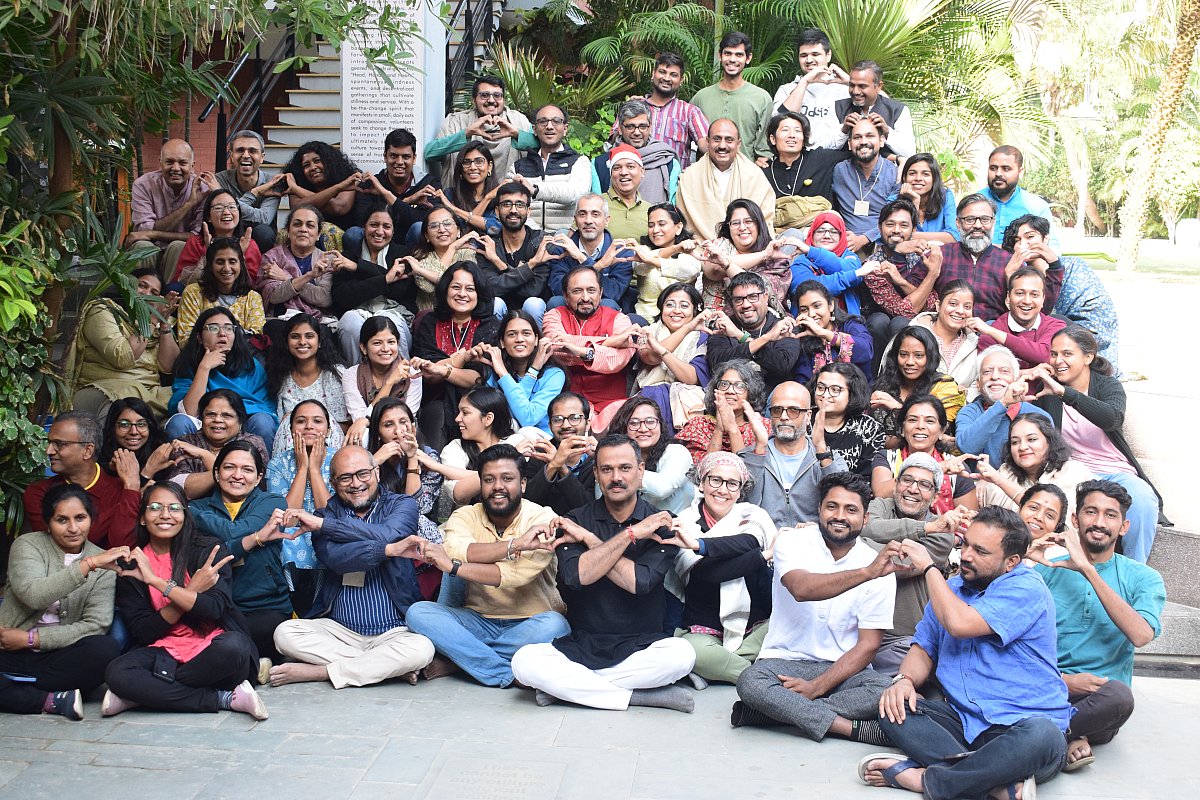
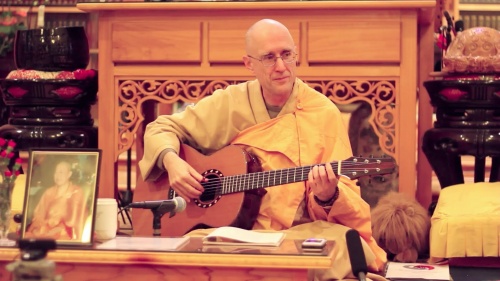
Last week, I spoke to a semi-big group of Art of Living youngsters interested in meditation and service. It was a dynamite session, coupled with a private audience with Sri Sri Ravi Shankar himself. Everything lived up to my expectations.
And then two days, I spoke at a Friendly Favors event. It was in the Walnut Creek dining room of Sergio Lub, Favors founder, with 9 of us huddled over potluck dinner. Entrance fee was $40. As I walked in, people were fidgety, drinking wine, two dogs and a cat running running around the house. Before I even start, they passed around an envelope to donate to a charity of my choice. None of it was what I had expected. :)
That's the thing about gift-economy, though. :) You take what's given, and give what's taken.
In recent months, Charlie Hess has been a close friend/fan of CharityFocus and its gift-economy exploits. Despite being a major mover and shaker on Wall Street, he's very humble. Right out of college, he started a company that he's still running, thirty-plus years later; they observe lots of data, make intelligent correlations, predict change patterns in diagnostic, doctor-like way. Tao Jones Averages is one of the books he's co-authored.
In the past decades, they've made lots of remarkable predictions that has earned them lots of respect in the commercial world, but he's now seeing a pattern emerge of people wanting to do work that inspires them; and he wants to do something about it. :) Already, more than dozen CF'ers are in touch with him and I sense you'll be hearing more from him in the coming months.
This morning, Charlie and I were talking about the nuances of effectiveness and efficiency. When I used the hamster example as efficient but not effective, he quickly sent me this wonderful cartoon:
On July 17, Al Gore delivered a strong speech on the need for the U.S. to produce its electricity solely from renewable and carbon-free sources within 10 years.
Apart from the speech, it's interesting to note the URL advert -- wecansolveit.org -- that now has 1.5MM registered users.
The author of Wonderous Toy Wokshop, Nancy Miller, wrote a thank-you note after being overwhelmed by responses from a DailyGood feature:
Dear Generous Friends,
[...] Because Hanni doesn't have a computer, your tender, loving messages to her were forwarded to me, and I must tell you that the tears came as I read them--such an outpouring of love and genuine admiration from each of you. I'm writing to you now to say thank you on Hanni's behalf and to tell you what has happened with your messages.
First, I called Hanni, in Mexico, where she lives now, and read them to her. I can't adequately tell you what they meant to her; it was an emotional experience for both of us. Then I collected all your messages and put them into a small, attractive, spiral-bound booklet and sent several copies to her in Mexico. She hadn't yet received them when I spoke to her two days ago, but they'll get there.
Hanni is not at all well now, but the gift of your words has been priceless and the best medicine she could ever have been given. So thank you, thank you--from both of us. [...]
Nancy Miller
The other note was something that would make any CF'er crack up: Where do you get all these good thoughts from? Don't you incure a loss in providing free service to people?
Imagine if elders of Native American community voted on a YouTube videos or Digg stories. Clearly, we'd have a VERY different set of stories that made it to the top. :) So a reasonable question to ask is: can we integrate popularity and expert opinion in a seamless spectrum that includes everyone but avoids the tyranny of the majority?
That's the question Brad DeGraf's Smartocracy is exploring.
In a traditional poll, every person gets one vote; as a result, least-informed voters get same influence as the wisest amongst us. In a dynamically distributed democracy, an ad-hoc group is empowered with proxies from uninformed representatives to accomodate a pool of users with fluctating degrees of participation.
A third alternative, though, is a trust-driven process for network based decision making -- Proxy Vote. So let's say you have 100 coordinators of CharityFocus. Each is given 10 proxies to give to others, within or outside of the existing network. And iteratively, each new member is also given 10 proxies to give to others they invite. At the time of a vote, each participant will have a precise number of votes equal to the number of invitations they received. In the figure here, you can see that I-circle has most votes because it has five incoming arrows. Essentially, you bias the votes based on network reputation and trust.
In offline networks, the "edges" aren't always so easily pointed in one direction. Developing trust in person is a complicated process. But in niche, online networks, we can perhaps simplify domain-specific trust.
Coming to think of it, we're already implementing a variant of a proxy vote with the help of our alternative currency -- KarmaBucks.
While Deepak and Manvi were browsing through a book store in India, they ran into a random book -- "Chicken Soup For the Indian Soul." Leafing through the book, he was moved by the first story he read, and thought of buying that book for the CharityFocus Intergalactic headquarters. :)
A few minutes later, he discovered that the story was written by none other than Pavi! Looking through the index, he noticed my name and a few others and decided to buy six copies. By the time he returned to SF, he'd already given away five of those copies, but we did get to see one copy. :)
As I excitedly looked through the index, the first story in the book was by none other than Freya. Second one was by Jagatbhai (at Manav Sadhna). Lots of HelpOthers stories. Many others from friends like Jayesh Patel to Mallika Chopra. It felt like a CharityFocus book. :)
After the initial oh-wow-so-cool wears off, you do wonder about the cultural insensitivity of "Chicken Soup", about the commercialization of kindness stories, about implicitly promoting a brand that you know nothing about. It's a tricky thing. On our end, we paid forward all monies (Rs. 500 for each selected story) to local NGOs in India and asked them to ensure that our content stayed uncopyrighted and freely available in the public domain.
A fun little event in the unfolding of CharityFocus. :)
Indra Nooyi -- PepsiCo's CEO, listed in Time's Top 100 influentials around the globe -- was recently asked by Fortune magazine: What was the best advice you ever got? She had a great response:
My father was an absolutely wonderful human being. From him I learned to always assume positive intent. Whatever anybody says or does, assume positive intent. You will be amazed at how your whole approach to a person or problem becomes very different. When you assume negative intent, you're angry. If you take away that anger and assume positive intent, you will be amazed. Your emotional quotient goes up because you are no longer almost random in your response. You don't get defensive. You don't scream. You are trying to understand and listen because at your basic core you are saying, "Maybe they are saying something to me that I'm not hearing." So "assume positive intent" has been a huge piece of advice for me.
In business, sometimes in the heat of the moment, people say things. You can either misconstrue what they're saying and assume they are trying to put you down, or you can say, "Wait a minute. Let me really get behind what they are saying to understand whether they're reacting because they're hurt, upset, confused, or they don't understand what it is I've asked them to do." If you react from a negative perspective - because you didn't like the way they reacted - then it just becomes two negatives fighting each other. But when you assume positive intent, I think often what happens is the other person says, "Hey, wait a minute, maybe I'm wrong in reacting the way I do because this person is really making an effort."
When you break it down, fame means two things: a lot people care for what you have to say, and you can't reciprocate that attention. This is why it's "lonely at the top of the pyramid", that's why fame shows up in limousines with stand-off-ish and click-ish characters, and that's why famous people often spread too thin. Being famous is actually a nightmare, in terms of quality of life. Imagine gift-economy economy where you can't reciprocate -- it's not really much of an economy, or culture or anything else.
The broadcast model of yester-decades created many famous people. We iconified heroes, often overlooking glaring shortcomings. That's the way things were.
Today, though, the internet has shifted us into a new paradigm of mirco-fame. Pandering to its fame-hungry readers, NY Magazine just published a long article on 8-steps-to-micro-fame. :) Still, it hosts a pretty good definition of the status-quo:
When we say "microfamous," our inclination is to imagine a smaller form of celebrity, a lower life-form striving to become a mammal—the macrofamous or suprafamous, perhaps. But microfame is its own distinct species of celebrity, one in which both the subject and the "fans" participate directly in the celebrity's creation. Microfame extends beyond a creator's body of work to include a community that leaves comments, publishes reaction videos, sends e-mails, and builds Internet reputations with links.
Where traditional fame was steeped in class envy on the part of the audience and alienation on the part of the celebrity, microfame closes the gap between devotee and celebrity. It feels like a step toward equality. You can become Facebook friends with the microfamous; you can start IM sessions with them. You can love them and hate them at much closer proximity. And you can just as easily begin to cultivate your own set of admirers. Though an element of luck often plays a role in achieving traditional fame, microfame is practically a science. It is attainable like running a marathon or acing the LSAT. All you need is a road map.
When I came across this magazine called 'Contact', it sounded very familiar.
"Started by an American traveller in 1997, a monthly magazine called distributed free of cost has traversed a long way. Run by volunteer editors and freelance contributors, it has now become a window to the various facets of life in Mcleod Ganj, a picturesque settlement of Tibetan refugees in northern India." more >>
Last April, in conversation with Deepak Chopra and friends at Alliance for New Humanity, I posed a few questions that might be useful for us as well:
Smallisthenewbig.A study, just out today, shows that while Facebook and Myspace isthe social networking buzz, people find that it isthe smaller social networks that are more effective. So perhaps becoming the next big network isthe wrong way to go?
Cooperation is a competitive advantage. Harvard Business Review noted that a dramatic shift in corporate strategy, from protecting intellectual property to sharing it (ie. open sourcing it). What are the other implications of a networked economy?
Everyone is a superstar. Malcolm Gladwell popularized "connectors" to spread ideas, but more recently, Duncan Watts noted that in a connected world, 'Tipping Point is Toast' and that everyone counts equally. Can everyone truly be recognized as a change maker?
Free isthe in-thing. Chris Anderson's cover story for February's Wired magazine was: "Free: Why $0.00 isthe Future of Business." Perhaps it's time for the gift-economy?
Word of mouse spread ideas for free. Harry Potter's Wizarding World at Universal Orlando Resort news spread to 350 million people, because of 7 fans who worked for free. Instead of wasting time manipulating messages and mediums, can we outsource marketing to the masses?
Groups form without organizations. With the internet, almost-zero coordination costs allows ad-hoc groups of people to challenge institutional productivity, from operating systems to encyclopedia. Clay Shirky's recent besteller, Here Comes Everybody, talks about this new era of organizing. What happens when self-organization starts scaling?
Spiritual sector is late adopter. Corporate sector dictates the innovations, non-profit sector create replicas a few years later and spiritual sector usually gets to it after the party's over. Perhaps theblack swanis for the spiritual sector to lead the next round of innovations?